Developed in collaboration with Adeerya Johnson, Associate Curator at the Museum of Pop Culture, the Henry presents Speculative Landscapes.
This two-part series evokes the American South and the ethos of Black science fiction as a means of experiencing the histories and futures embedded in
Rodney McMillian: Neighbors.
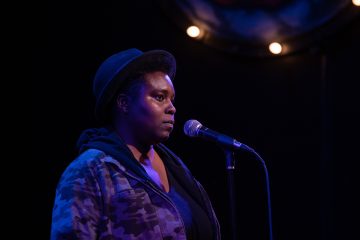
For this iteration, join poet and artist Anastacia-Reneé for an afternoon of reading and conversation, exploring ghosts, ancestry, and erasure.
Bios
Anastacia-Reneé is an award-winning writer, educator, interdisciplinary artist, TEDx speaker, playwright, and podcaster. She is the author of the debut fiction-hybrid book, Here in the (Middle) of Nowhere, and two books of poetry, Side Notes from the Archivist and (v.). Her mixed media art has been exhibited at the Frye Art Museum and her installation, (Don’t Be Absurd): Alice in Parts, was selected by NBC News as part of the list of “Queer Artist of Color Dominate 2021’s Must See LGBTQ Art Shows.” She has received fellowships and residencies from Cave Canem, Hedgebrook, VONA, The White Center, Mineral School, Ragdale, 4Culture, and The New Orleans Writers Residency. Reneé’s poetry, fiction and nonfiction has been anthologized and published widely.
Dr. Adeerya Johnson is an Associate Curator at the Museum of Pop Culture whose curatorial and scholarly work centers Black Studies and the preservation of Black cultural memory within museums. She holds a PhD in Gender, Race, Sexuality, and Social Justice from the University of British Columbia and is a proud Alumna of Spelman College. Dr. Johnson specializes in African American music, hip-hop, and visual culture, with a particular focus on the U.S. South and Black women’s expressive cultures with her research, Dirty South Feminism. At MoPOP, she’s curated exhibitions including Never Turn Back: Echoes of African American Music, Massive: The Power of Pop Culture and My Mic Sounds Nice: Hip-Hop Feminism in History, foregrounding Black feminist, community-centered, and anti-racist curatorial methodologies. Trained as a Digital Collections Archivist, Dr. Johnson bridges Black Studies scholarship and museum practice, positioning African American exhibitions as vital sites of cultural affirmation and historical reckoning.
![<p><i>Public Opening: Fall Exhibitions </i>[Event documentation, Henry Art Gallery, University of Washington, Seattle. 2025]. Photo: Jo Cosme.</p>](https://henryart.org/assets/img/_smallImage/JoCosme_October-3rd_Fall-exhibition-opening-010WEB.jpg)