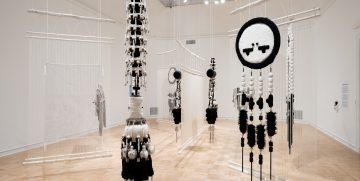
(Re)Source: Indigenous Practices + Lo-Fi Aesthetics
To celebrate the culmination of the exhibition,
ojo|-|ólǫ, join
Eric-Paul Riege with guest artists
Olivia Camfield and
Kole Galbraith for a multi-day convening of film screenings, performances, and conversations. Inspired by the modularity of Riege’s work in which materials and motifs are re-worked and re-imagined in perpetuity, the artists will explore how history and culture are neither static nor permanent. To close the convening, join Riege, Camfield, and Galbraith as they source new meanings from the sounds, materials, and images of both the past and present, challenging high art through lo-fi means.
Thursday, October 1
6:00 – 7:30 PM
Auditorium Film + video screening featuring Eric-Paul Riege, Olivia Camfield, and Kole Galbraith in conversation with Diana Ruíz, Assistant Professor, Cinema + Media Studies
Saturday, October 3
1:00 PM – 4:00 PM
Upper Level GalleriesDurational performance with Eric-Paul Riege, Olivia Camfield, and Kole Galbraith
Bios
Eric-Paul Riege (Diné) is a weaver and fiber artist working in collage, durational performance, installation, woven sculpture, and wearable art. Using weaving as both means and metaphor to tell hybrid tales that interlace stories from Diné spirituality with his own interpretations and cosmology, he understands his artworks as animate and mobile. His practice pays homage and links him to generations of weavers in his family who aid him in generating spaces of sanctuary. Riege’s recent solo exhibitions include iiZiiT [3]: RIEGE Jewelry + Supply at Canal Projects, New York (2025), Hammer Projects: Eric Paul Riege at the Hammer Museum, Los Angeles (2022–2023), and Hól ́ǫ—it xistz at the Institute of Contemporary Art Miami (2019). His recent group exhibitions include the 24th Biennale of Sydney in Australia (2024), Indian Theater: Native Performance, Art, and Self-Determination (2023), Prospect.5 Triennial in New Orleans (2022), and the Toronto Biennial of Art (2022). He holds a BFA in Art Studio and Ecology from the University of New Mexico in Albuquerque. His work is collected by Forge Project and ICA Miami, among others. He is represented by Bockley Gallery (MN) and STARS Gallery (CA). Riege is a member of the Charcoal Streaked Division of the Red Running Into the Water clan. He was born and is based in Na’nízhoozhí [Gallup, New Mexico].
Olivia Camfield is a multimedia movement artist of the Muscogee Nation, born and raised in the Texas Hill Country. Their work finds connection of dance as body horror, tattooing as protection spells, and farming as Queer Indigenous Futurism. They have performed and choreographed dance for much of their career, and their film work includes themes of the Alien as kin, time traveling relatives, and Mvskoke lifeways in experimental forms. They are a tattoo artist whose hand poke practice is based in Southeastern and Mississippian Indigenous tattoo traditions, creating designs for Southeastern people that imagine the possibilities of those tattoos' into the future and the new shapes they may take. Since becoming a farmer in 2020, Olivia began the journey of becoming an Indigenous Seed Saver by learning seed saving techniques, researching historically stolen varieties, and participating in seed rematriation while working on farms. They are now finding the intersections of their artist practice and aesthetics and the ongoing work of Missisipian/Southeastern seed keeping. Olivia's films have screened internationally at Camden International Film Festival, Ann Arbor Film Festival, ImagineNATIVE Film and Media Arts Festival, and have appeared in print and online publications including ArtForum and Variety. Olivia was a 2018-2019 Alembic Artist In Residence, CYCLE I featured artist of COUSIN Collective, and 2022 Sundance Institute Indigenous Non-Fiction Intensive participant, and a 2022 NACF LIFT awardee.
Kole Galbraith (Peoria/Sinixt) is a sound, and audio-visual performance/installation artist based in Seattle, Washington, Kole Galbraith has been active in the underground experimental music community for the past decade performing throughout North America and Europe. Sonically the studio compositions are informed by early 20th century French musique-concrète, harsh noise, free-jazz and contemporary composition. Thematically, the compositions are influenced by interior Salish folklore, and contemporary indigenous experience. Galbraith mixes using materials found in nature with electronic techniques to uncover both latent sonic capabilities and to uncover latent histories. Galbraith has released albums on his own label, Obscure & Terrible, and other labels such as SIGE, Titania Tapes and Krim Kram. Galbraith has worked with musicians including Lori Goldston, Greg Kelley, Jessika Kenney, Steve Moore, Warren Realrider, Nathan Young, Catherine Guesde, AL Jones, Zach Rowden, Casey Adams, Patrick Wurzwallner, Jason Lazer, morher, Wilson Shook, and Noel Kennon."
Diana Flores Ruíz is a feminist media scholar studying the material and cultural infrastructures of bordering regimes and the ways in which artists and activists contend with surveillant technologies. By bridging studies of carceral optics and abolitionist visual practices, she situates analyses of state capture within a longer historical continuum of settler colonial visual regimes and creative anticolonial resistance. Dr. Ruíz is Assistant Professor of Race and Media in the department of Cinema & Media Studies at the University of Washington, where she also holds affiliate faculty appointments in the departments of Human Centered Design & Engineering, Comparative Histories of Ideas, and Gender, Women & Sexuality Studies. In 2025-2026, her work was supported by a Mellon Career Enhancement Fellowship. Her writing appears in Journal of Visual Culture (forthcoming), Critical Ethnic Studies, Feminist Media Histories, Film Quarterly, the Journal of Cinema and Media Studies, and Temporal Territories: An Anthology on Indigenous Experimental Cinema (COUSIN Collective and Light Industry, 2024), among other venues.